Forward deployed engineering skills for AI coding agents.
Understand the customer. Design and build the solution. Verify it and hand it over. Use individual skills in your AI coding agent or let fde coordinate.
npx skills add suboss87/fdeops --skill fdeUse with a compatible AI coding agent
- Claude Code
- Cursor
- Codex
- Copilot
- Windsurf
- Gemini CLI
- Cline
Setup and invocation differ by agent. Claude Code has a plugin with session hooks. Other hosts use installed skills and optional workspace adapters. Check the setup guide for your agent.
Start with the work in front of you.
You can join at kickoff, take over an existing system or fix one integration. These are starting points, not a required sequence.
Understand the customer problem
Clarify the request, trace the current process and identify missing evidence.
Decide what to build
Compare approaches and agree scope, owners and acceptance checks.
Implement and connect
Change the existing code, connect customer systems and investigate failures.
Verify the result
Review the change, evaluate AI behavior and test the user's actual task.
Deliver with evidence
Prepare an authorized release and explain what was implemented, verified and accepted.
Why I built FDEOps
I built FDEOps around how I approach customer work: start with the real problem, question assumptions, understand the wider system, and test decisions against evidence. The skills bring that approach into your AI coding agent.
Subash Natarajan, creator of FDEOps
One task or the whole engagement.
Use an individual skill
Use plan to choose a delivery path, build to implement a change or review to check it. Start with the task you need.
Coordinate a customer project
Give fde the customer context and the task. It selects the skills for discovery, design, implementation and delivery. Customer decisions and evidence stay connected as the work moves forward.
The fde coordinator skill includes the instructions it needs. Install individual skills when you want to call them separately by name.
Carry customer context into the next task.
Customer memory supports the work: agreed scope informs the build, acceptance checks guide verification, and saved evidence helps you resume. Each customer has a separate local record.
~/fde-engagements/client01/.fde/
- brief.mdWhat the customer asked for.
- success.mdThe agreed outcome and who can accept it.
- decisions.mdDecisions, reasons and supporting sources.
- delivery.mdWhat was promised, measured and accepted.
- risks.mdOpen risks and their owners.
- context.mdCurrent state and next actions.
Review proposed agreements before saving them. A passing test is not a production release, and saving a result does not mean the customer accepted it.
See what needs attention.
The fieldbook is a read-only browser view of your customer records. It brings together next actions, open risks and missing evidence. Regenerate it after records change.
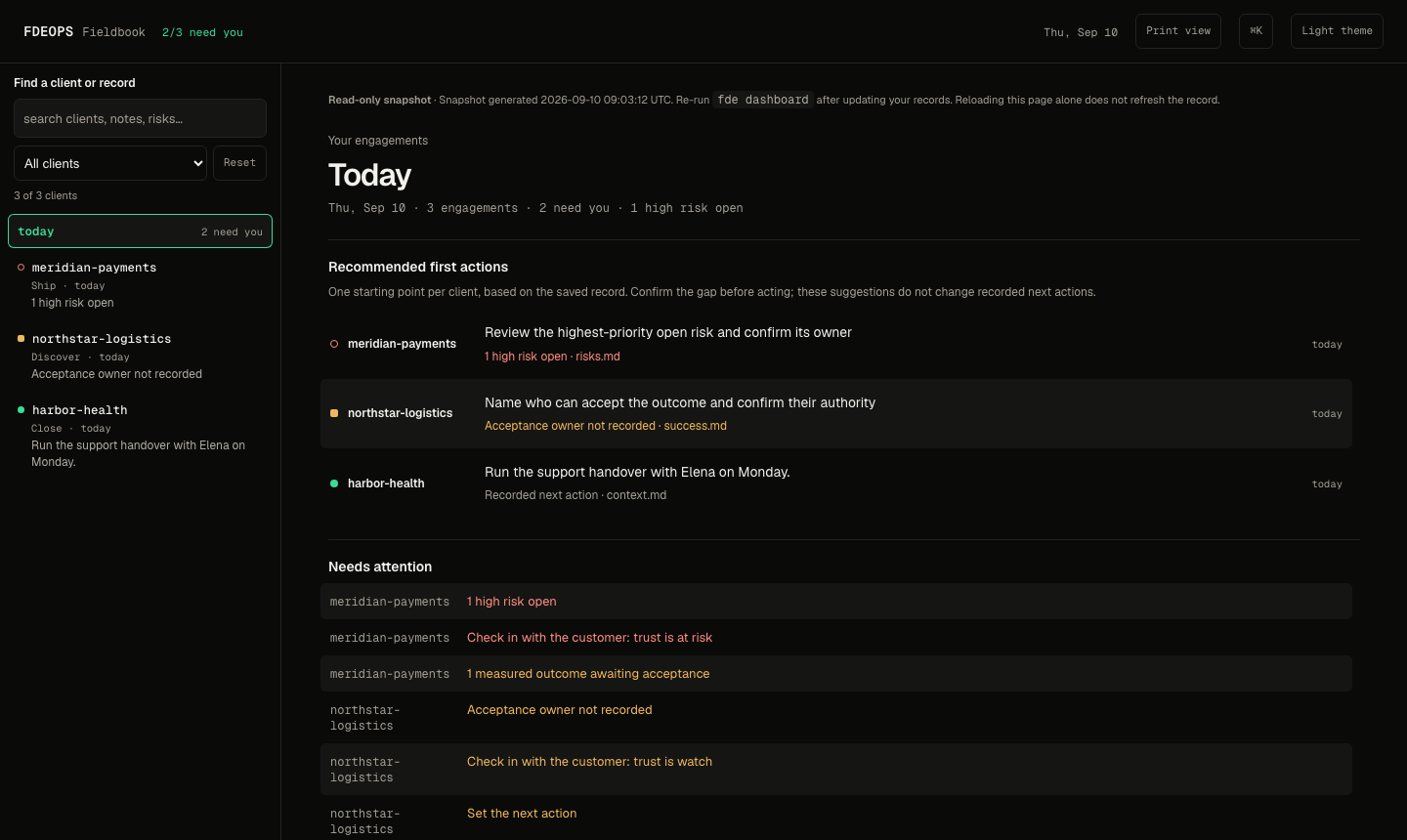
Fictional customer data
See the walkthroughLearning forward deployed engineering?
Understand the role, choose what to practice and build evidence of your work.
Understand the role
What a forward deployed engineer does, and how it differs from solutions and product engineering.
Follow the learning roadmap
A practical roadmap: the capabilities to build, your starting point, and the evidence that shows your work.
Prepare for interviews
Practice engineering and customer scenarios, and prepare evidence you can explain.
Field notes
A clearer next move in customer work.
FDE field notes on the decisions behind discovery, delivery and handoff.
Delivered through Substack. Unsubscribe at any time.
Questions before you start.
Bring FDEOps into your next customer task.
Use one task skill or let fde help you work across the project. Start with the notes or code you already have.